
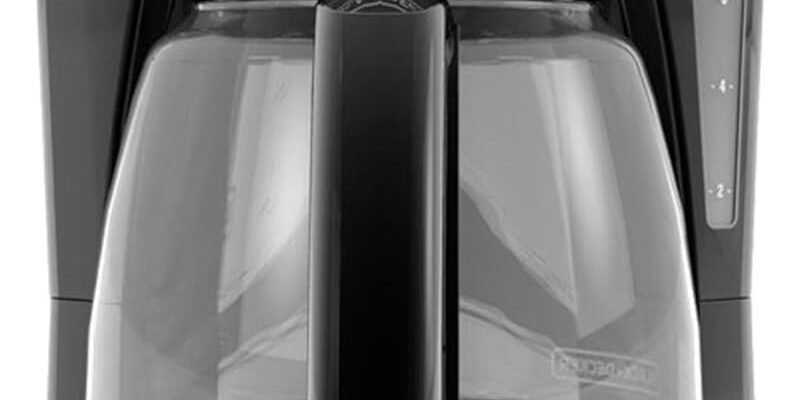
A drip coffee maker remains one of the simplest ways to prepare several cups of coffee at once. While single-serve machines can be convenient for individual portions, a traditional carafe-style brewer can make more sense when coffee is shared between several people or when someone prefers to prepare a larger batch in one cycle.
The BLACK+DECKER 12-Cup Programmable Coffeemaker, model CM1160B, is designed around that familiar drip-brewing format. It combines a 12-cup capacity with programmable controls, a glass carafe, a removable filter basket, a water-level window, and features intended to make everyday brewing more convenient. The model is also associated with Vortex Technology, a showerhead design intended to distribute water over the coffee grounds during brewing.
This type of coffee maker is aimed at straightforward preparation rather than specialty espresso-style drinks. It uses ground coffee and a drip-brewing process, making it suitable for traditional brewed coffee, larger batches, and routines where having coffee ready at a particular time is useful.
The term “12-cup” also deserves some explanation. Coffee-machine manufacturers commonly use a smaller serving measurement than a standard 8-ounce household cup. BLACK+DECKER states that its coffee-maker cup measurement is approximately 5 ounces, although the actual amount can vary depending on brewing technique.
This article explores the BLACK+DECKER CM1160B from an informational perspective. It looks at the main features, how Vortex-style water distribution works, practical ways to use the machine, cleaning and maintenance considerations, and how this type of brewer compares with other general coffee-maker categories.
Introduction to the BLACK+DECKER 12-Cup Coffee Maker
Drip coffee brewing works by heating water and distributing it over ground coffee held inside a filter. The brewed coffee then flows into a carafe positioned underneath the filter basket.
The method is relatively straightforward, but small design differences can affect how convenient the process is.
A household may want:
- A larger brewing capacity
- Programmable brewing
- A visible water reservoir
- A pause-and-pour function
- Easy-to-clean components
- A glass carafe
- Consistent water distribution
The BLACK+DECKER CM1160B is designed around these everyday requirements.
The manufacturer currently lists the CM1160B among its 12-cup programmable coffee makers, while a related BLACK+DECKER product listing identifies the CM1160B-1 as the 12-Cup Programmable Coffeemaker in black.
The machine is particularly relevant to households that prefer traditional brewed coffee rather than single-serve pods or espresso-based preparation.
Key Features of the BLACK+DECKER CM1160B
12-Cup Brewing Capacity
The headline specification is the 12-cup brewing capacity.
As mentioned above, the “cup” measurement used by coffee makers is smaller than a conventional 8-ounce cup. BLACK+DECKER specifies approximately 5 ounces per cup, with the actual amount varying according to brewing technique.
This means the machine’s stated 12-cup capacity should not be interpreted as twelve full 8-ounce mugs.
In practical terms, the capacity is intended for preparing a relatively large carafe of coffee in one brewing cycle.
That can be useful for:
- Families
- Shared households
- Home offices
- Small gatherings
- Breakfast service
- People who drink multiple cups throughout the morning
The larger capacity can also reduce the need to brew multiple small batches.
Vortex Technology
One of the notable features associated with this BLACK+DECKER coffee maker is Vortex Technology.
The idea behind this design is to distribute brewing water over the coffee grounds rather than allowing water to concentrate primarily in one area.
BLACK+DECKER describes its Vortex Technology showerhead as a design intended to evenly saturate the coffee grounds using water flow during brewing.
In a drip coffee maker, water distribution matters because the grounds need sufficient contact with water for extraction.
If water reaches some areas much more heavily than others, the grounds may not contribute equally to the brewing process.
A showerhead-style distribution system is therefore intended to help spread water across the coffee bed.
It is important, however, not to interpret the technology name as a guarantee of a particular flavor profile. The final coffee also depends on:
- Coffee bean quality
- Roast level
- Grind size
- Coffee-to-water ratio
- Water quality
- Freshness
- Filter type
- Brewing conditions
The brewing system is one part of the overall process.
Programmable Brewing
The programmable function is designed for people who want coffee preparation to fit into a particular schedule.
Instead of manually starting the machine every morning, the user can program the brewing time in advance.
For example, someone might prepare the coffee maker before going to bed and set the desired brewing time for the following morning.
This can be useful for:
- Early work schedules
- School mornings
- Shared households
- Regular breakfast routines
- Office preparation
The important distinction is that programmability provides scheduling convenience; it does not eliminate the need to prepare the machine correctly beforehand.
Coffee grounds, the filter, and the appropriate amount of water still need to be added.
QuickTouch Digital Controls
The coffee maker uses digital controls intended to simplify programming.
A control system can be particularly useful for scheduling the automatic brewing function because users need to set the clock and select a brewing time.
BLACK+DECKER uses the term QuickTouch Programming for the control approach used across several of its programmable coffee makers. Its current product information describes QuickTouch as a way to set the clock and program the auto-brew function.
For everyday use, the controls are primarily about operating the machine rather than providing a large selection of specialty coffee recipes.
Sneak-A-Cup Function
The Sneak-A-Cup feature is designed for situations where someone wants to pour a cup before the entire brewing cycle has finished.
BLACK+DECKER describes the feature as temporarily stopping the flow of coffee when the carafe is removed, allowing a cup to be poured before the rest of the pot is finished.
This can be useful in households where people do not always want to wait for a full pot.
For example, if the coffee maker is still brewing and someone needs a cup before leaving for work, the feature provides a way to pause the flow.
The function is intended to reduce dripping during this process.
Users should still follow the manufacturer’s instructions when removing and replacing the carafe during brewing.
Glass Carafe
The CM1160B uses a glass carafe.
Glass carafes are common with traditional drip coffee makers and provide a straightforward way to see how much coffee remains.
They also work with a warming plate beneath the carafe.
A glass carafe can be convenient for households that want to visually monitor the remaining coffee rather than relying on markings or an opaque container.
At the same time, glass requires normal care when handling.
Avoid sudden impacts, and follow the manufacturer’s cleaning instructions.
Keep-Warm Plate
After brewing, the glass carafe sits on a heated plate designed to keep the coffee warm.
This can be useful when several people are drinking coffee at different times.
For example, one person may have coffee immediately after brewing while another has a cup later.
The keep-warm function is different from a thermal carafe.
A thermal carafe is designed to retain heat through insulation, whereas a glass-carafe machine generally uses an external warming plate.
This distinction matters when comparing coffee-maker categories.
Removable Filter Basket
A removable filter basket provides access to the area where coffee grounds and the filter are placed.
This makes it easier to:
- Add coffee
- Remove used grounds
- Rinse the basket
- Clean accumulated residue
BLACK+DECKER lists removable filter baskets among the features used in its drip coffee-maker designs, including its programmable models.
The exact filter requirements should be checked against the manual for the specific CM1160B configuration.
Water-Level Visibility
A visible water-level window can help when filling the coffee maker.
Rather than estimating the amount of water, users can check the markings while filling the reservoir.
This can be especially useful when making different batch sizes.
For example:
- A smaller amount for one or two people
- A medium batch for a few cups
- A larger batch for a household or gathering
The water level should always remain within the appliance’s specified limits.
How the BLACK+DECKER Coffee Maker Can Be Used
The machine’s primary purpose is straightforward drip coffee preparation, but there are several ways to integrate it into everyday routines.
Preparing a Morning Pot
The most common use is preparing a batch of coffee in the morning.
A basic process involves:
- Fill the reservoir with the desired amount of water.
- Place an appropriate filter into the basket.
- Add ground coffee according to the recipe or preferred coffee-to-water ratio.
- Place the carafe correctly.
- Select the appropriate controls.
- Start the brewing cycle or use the programmed schedule.
The precise quantities should follow the manufacturer’s instructions and the user’s preferred recipe.
Scheduling Coffee for the Morning
The programmable function can be useful when the same routine occurs every day.
For example:
Evening
Prepare the filter, coffee grounds, and water.
Before bed
Set the desired brew time.
Morning
The brewing cycle begins according to the programmed schedule.
This approach can reduce the number of steps required immediately after waking.
It is particularly useful when the household follows a relatively consistent schedule.
Brewing for Multiple People
The larger carafe capacity makes this type of machine suitable for shared coffee routines.
Instead of preparing one cup at a time, a full batch can be brewed for several people.
This can be useful during:
- Breakfast
- Weekend mornings
- Family gatherings
- Small meetings
- Home-office workdays
Each person can pour from the same carafe.
Preparing Smaller Batches
Although the machine is marketed as a 12-cup coffee maker, not every brewing session needs to involve the maximum amount.
Smaller quantities can be appropriate when fewer people are drinking coffee.
The important point is to follow the minimum and maximum quantities specified by the manufacturer and use an appropriate coffee-to-water ratio.
A smaller batch may also brew differently from a full batch, so recipe adjustments may be necessary.
Using Different Coffee Beans
A drip coffee maker can accommodate many types of ground coffee.
The choice of beans can dramatically change the resulting cup.
Examples include:
- Light roast
- Medium roast
- Dark roast
- Single-origin coffee
- Blended coffee
- Decaffeinated coffee
The machine itself does not determine the coffee’s flavor.
The beans, roast, grind, and water all play significant roles.
Grinding Coffee Before Brewing
If whole beans are used, they need to be ground before being placed in the filter basket unless a separate grinder is being used.
A medium grind is commonly associated with drip brewing, although the appropriate grind can vary according to the coffee and desired extraction.
A grind that is too fine can slow water flow, while a grind that is too coarse can affect extraction.
For someone experimenting with coffee quality, grind size can be one of the more meaningful variables to adjust.
Adjusting Coffee Strength
Coffee strength can be influenced by the amount of coffee used relative to the amount of water.
If a cup tastes too weak, one possible adjustment is to increase the amount of ground coffee rather than simply reducing the water dramatically.
If it tastes too strong, the opposite adjustment may be appropriate.
It is better to change one variable at a time when experimenting.
That makes it easier to identify what produced the difference.
Using Fresh Coffee
Coffee freshness matters regardless of the brewing machine.
Ground coffee gradually loses aroma after grinding because more of its surface area is exposed to air.
For this reason, grinding whole beans shortly before brewing can be useful for people who prioritize freshness.
However, pre-ground coffee remains convenient and can work well with a drip coffee maker when stored properly.
Choosing the Right Filter
The appropriate filter depends on the coffee maker’s design and manufacturer’s recommendations.
Filters serve two main purposes:
- They hold the coffee grounds.
- They allow brewed coffee to pass into the carafe.
Using an incorrectly sized filter can lead to poor fit or overflow.
Always verify the recommended filter type for the CM1160B.
Brewing Coffee for a Home Office
A 12-cup drip coffee maker can be useful in a home-office environment where several cups may be consumed throughout the workday.
Instead of making individual servings repeatedly, one batch can be prepared in advance.
The keep-warm plate can maintain the coffee’s temperature for a period after brewing.
However, coffee quality can change when brewed coffee remains on a hot plate for a long time.
For that reason, it can be preferable to brew an amount that matches expected consumption rather than leaving the same pot sitting for many hours.
Using the Coffee Maker During Gatherings
A larger carafe can also simplify coffee service during small gatherings.
The host can brew a batch and allow guests to serve themselves.
This can be useful for:
- Breakfast gatherings
- Brunch
- Family visits
- Informal meetings
- Holiday mornings
A programmable brewer can also be prepared in advance when the event follows a predictable schedule.
Who the BLACK+DECKER 12-Cup Coffee Maker May Be Suitable For
Families
Households with several coffee drinkers may appreciate a larger carafe format.
A single brewing cycle can provide several servings.
Couples
Couples who both drink coffee can use a shared brewer rather than preparing individual servings.
The remaining coffee can be kept warm for a limited period.
Home Offices
A larger batch can be practical when coffee is consumed throughout a work session.
Traditional Coffee Drinkers
People who prefer standard brewed coffee over capsules or espresso machines may find the drip format more familiar.
People With Consistent Schedules
The programmable function is particularly relevant to people who have predictable morning routines.
Important Things to Consider
“12 Cups” Does Not Mean Twelve 8-Ounce Mugs
This is one of the most important points to understand.
BLACK+DECKER defines a coffee-maker cup as approximately 5 ounces, although actual volume can vary depending on brewing technique.
Therefore, a 12-cup machine should not be interpreted as providing twelve large mugs.
If your household typically drinks 10-ounce or 12-ounce mugs, the number of servings obtained from a full pot will naturally be smaller.
Glass Carafe Versus Thermal Carafe
The CM1160B uses a glass carafe and warming plate.
A thermal coffee maker uses an insulated carafe instead.
The two systems approach heat retention differently.
Glass Carafe
Coffee remains on a heated surface after brewing.
Thermal Carafe
The carafe itself is designed to retain heat through insulation.
Neither format is automatically appropriate for every household.
A glass carafe provides visible coffee level and a familiar brewing setup. A thermal carafe can be useful for people who prefer not to keep coffee sitting on a warming plate.
Coffee Quality Is Not Determined by the Machine Alone
A coffee maker can influence extraction, but it cannot compensate for every variable.
The final cup also depends on:
- Bean quality
- Roast
- Freshness
- Grind size
- Coffee-to-water ratio
- Water quality
- Filter
- Storage
A good brewing routine starts with suitable ingredients.
Water Quality Matters
Coffee is mostly water, so the quality of the water used can influence the finished drink.
If tap water has a strong taste or odor, that characteristic can become noticeable in coffee.
Filtered water can be an option for people who want more control over the water used for brewing.
However, water should still be used according to the appliance’s instructions.
Cleaning the Coffee Maker
Regular cleaning is an important part of drip coffee-maker ownership.
Coffee oils and mineral deposits can accumulate over time.
A basic cleaning routine includes:
- Emptying used coffee grounds
- Washing the removable basket
- Cleaning the carafe
- Wiping the exterior
- Cleaning the brewing area
- Descaling when necessary according to the manufacturer’s instructions
The exact cleaning process should follow the manual for the CM1160B.
Why Descaling Matters
Mineral deposits can build up inside a coffee maker when water passes through the internal heating system.
This can be more noticeable in areas with harder water.
Over time, buildup may affect the machine’s operation and water flow.
Descaling is therefore part of routine coffee-maker maintenance.
The correct cleaning solution and procedure should come from the manufacturer’s instructions rather than assuming that every coffee maker can be treated identically.
Cleaning the Glass Carafe
The carafe should be washed regularly to remove:
- Coffee residue
- Oils
- Staining
- Mineral deposits
A clean carafe can help keep old coffee residue from affecting later batches.
Avoid sudden temperature changes that could damage glass.
For example, placing a very hot glass carafe into very cold water is generally not a good practice.
Cleaning the Filter Basket
The filter basket is another area that benefits from routine cleaning.
Coffee grounds can leave oils and fine particles behind.
After brewing, remove the used filter and grounds and rinse the basket as appropriate.
If the model’s basket is dishwasher compatible according to its instructions, that option may be available. Otherwise, hand washing is appropriate.
Always confirm the specific care instructions for your model.
Avoiding Coffee Grounds in the Carafe
If grounds appear in the finished coffee, several factors may be involved.
Possible causes include:
- Incorrect filter placement
- Wrong filter size
- Overfilling the filter
- Damaged filter
- Incorrectly positioned basket
- Excessively fine coffee grounds
Checking the filter and basket setup is a sensible first step.
Comparing General Coffee Maker Categories
There are several broad types of coffee makers, and each serves a different purpose.
Traditional Drip Coffee Makers
This is the category to which the BLACK+DECKER CM1160B belongs.
These machines generally use:
- Ground coffee
- A filter
- A water reservoir
- A carafe
- An automatic brewing cycle
They are designed primarily for batch coffee preparation.
Single-Serve Pod Machines
Single-serve machines prepare one serving at a time using pods or capsules.
They can be convenient for individuals who want different drinks or flavors.
The trade-off is that they are not generally designed around preparing a large shared carafe.
Espresso Machines
Espresso machines use a different brewing method involving finely ground coffee and pressure.
They are designed for concentrated espresso and drinks such as:
- Lattes
- Cappuccinos
- Americanos
- Macchiatos
A traditional drip machine serves a different purpose.
French Press
A French press does not use an electric brewing system.
Coffee grounds steep in hot water before being separated using a plunger.
This can provide a different brewing experience and allows users to control steeping time directly.
Pour-Over Coffee Makers
Pour-over brewing involves manually distributing hot water over coffee grounds.
It gives the brewer significant control over water flow and timing.
The trade-off is greater hands-on involvement compared with an automatic drip coffee maker.
Thermal Drip Coffee Makers
Thermal drip machines combine automatic brewing with an insulated carafe.
They can be useful for people who want to keep coffee hot without relying on a heated plate.
The BLACK+DECKER CM1160B instead uses a glass carafe and warming-plate approach.
Practical Tips for Better Drip Coffee
Start With Fresh Coffee
Freshly roasted and appropriately stored coffee can provide a more aromatic starting point.
Grind Appropriately
A grind suited to drip brewing can help water pass through the coffee bed at an appropriate rate.
Measure Consistently
Use a consistent coffee-to-water ratio.
Changing the ratio from one batch to another makes it difficult to understand why the flavor changed.
Use Suitable Water
If tap water has a strong mineral or chlorine taste, filtered water may produce a different result.
Keep the Equipment Clean
Old coffee oils can accumulate and affect future batches.
Avoid Overheating Coffee for Too Long
The warming plate is useful for short-term holding, but coffee can change in flavor when kept hot for an extended period.
Brewing a quantity that matches expected consumption can help minimize waste.
Building a Simple Morning Coffee Routine
A programmable coffee maker can become part of a predictable routine.
Night Before
Add water.
Place the filter.
Measure the coffee.
Set the desired brewing time.
Morning
The machine begins its programmed cycle.
The coffee is collected in the glass carafe.
After Brewing
Pour coffee into a mug.
Remove or clean the used grounds and filter.
Rinse or clean the components as appropriate.
This process can reduce the number of decisions required during a busy morning.
Using the Sneak-A-Cup Feature Responsibly
The Sneak-A-Cup function can be useful, but it is best treated as a convenience feature rather than a reason to interrupt every brewing cycle.
If coffee is needed before the batch is finished, the function allows a cup to be poured while temporarily stopping the flow.
After pouring, the carafe should be returned correctly so brewing can continue.
Follow the manufacturer’s instructions for safe use.
Coffee for Different Household Preferences
A shared drip coffee maker can also accommodate different preferences through the choice of coffee rather than complicated machine settings.
For example, one household could use:
Morning: Medium roast
Weekend: Dark roast
Afternoon: Decaffeinated coffee
The machine provides the brewing platform while the coffee itself determines much of the flavor profile.
Managing Coffee Consumption
A 12-cup brewer can make it easy to prepare more coffee than is actually needed.
This can lead to wasted coffee if the entire carafe is brewed every time only one or two people want a cup.
A more efficient approach is to estimate how much will actually be consumed.
If the machine’s supported brewing range allows smaller batches, use an appropriate quantity rather than automatically filling the reservoir.
Frequently Asked Questions
What is the capacity of the BLACK+DECKER CM1160B?
The coffee maker is rated as a 12-cup brewer.
BLACK+DECKER defines one coffee-maker cup as approximately 5 ounces, although the actual serving volume can vary.
What type of coffee does it make?
It is designed for traditional drip coffee made from ground coffee.
It is not an espresso machine or a single-serve capsule brewer.
Does it use a glass carafe?
Yes. The CM1160B is associated with a glass carafe, consistent with BLACK+DECKER’s traditional 12-cup programmable coffee-maker format.
What is Vortex Technology?
Vortex Technology refers to the showerhead design used to distribute brewing water over the coffee grounds.
BLACK+DECKER describes the system as evenly saturating the grounds through its water-flow design.
Can the coffee maker be programmed?
Yes. The programmable function allows users to set the machine to brew coffee at a selected time.
BLACK+DECKER describes its QuickTouch controls as providing clock and auto-brew programming.
What is Sneak-A-Cup?
Sneak-A-Cup is designed to temporarily stop the flow of coffee when the carafe is removed, allowing a cup to be poured before the brewing cycle has finished.
Can I brew less than a full pot?
A drip coffee maker can generally be used for smaller batches within its specified operating range.
The exact minimum quantity should be confirmed in the manufacturer’s instructions.
Does it keep coffee warm?
The glass carafe sits on a warming plate designed to keep brewed coffee warm after the brewing cycle.
This differs from a thermal carafe, which retains heat through insulation.
How long can coffee remain on the warming plate?
The appropriate holding time depends on the specific model and the manufacturer’s guidance.
From a quality perspective, coffee can change in flavor when held hot for an extended period, so brewing an amount appropriate for expected consumption can be preferable.
Does it grind whole coffee beans?
No. The CM1160B is a drip coffee maker designed for ground coffee.
Whole beans need to be ground separately before brewing.
Can I use decaf coffee?
Yes. Decaffeinated ground coffee can be prepared using a drip coffee maker.
The brewing process is essentially the same, although the coffee-to-water ratio can be adjusted according to taste.
What grind size should I use?
A medium grind is commonly used for drip coffee, but the appropriate grind can vary with the coffee and desired extraction.
Extremely fine or coarse grounds may change water flow and extraction.
Does water quality affect coffee?
Yes. Since water makes up most of brewed coffee, its mineral content and taste can influence the final drink.
Filtered water can be useful if tap water has an undesirable taste.
How often should a drip coffee maker be cleaned?
The removable components should be cleaned regularly, ideally after brewing sessions according to the manufacturer’s instructions.
Internal descaling should be performed according to the manufacturer’s recommended maintenance schedule and the water conditions in the area.
Can the carafe go in the dishwasher?
Do not assume dishwasher compatibility unless it is specifically stated in the product instructions.
Check the manufacturer’s care guidance for the glass carafe and other removable components.
Why does coffee sometimes taste bitter?
Bitterness can have several causes.
Possible factors include:
- Very dark roast
- Excessive coffee extraction
- Very fine grind
- Too much coffee
- Water temperature
- Coffee held hot for an extended period
Changing one variable at a time can help identify the cause.
Why does coffee sometimes taste weak?
Weak coffee can result from:
- Too little ground coffee
- Too much water
- An overly coarse grind
- Coffee that has lost freshness
Adjusting the coffee-to-water ratio is one of the simplest variables to test.
Does Vortex Technology guarantee stronger coffee?
No technology can guarantee a particular flavor result for every coffee.
The Vortex showerhead is designed to distribute water over the coffee grounds, but the final flavor depends on the coffee, grind, ratio, water, and brewing conditions.
Choosing Between a 12-Cup Drip Coffee Maker and Other Options
The most appropriate coffee maker depends on how coffee is consumed.
If several people regularly drink traditional brewed coffee, a 12-cup drip machine can provide a practical batch-brewing format.
If one person drinks one cup at a time, a single-serve machine may better match that routine.
If the goal is espresso-based beverages, an espresso machine is designed specifically for that purpose.
If someone enjoys controlling every part of the brewing process, pour-over or French press may be more appealing.
The important question is not which category is universally superior. It is which brewing method matches the household’s habits.
Everyday Maintenance Checklist
A simple maintenance routine can help keep a drip coffee maker in regular use.
After Brewing
Remove used coffee grounds.
Dispose of the filter according to its type.
Rinse removable components.
Regularly
Wash the carafe.
Clean the filter basket.
Wipe the exterior.
Check for coffee residue around the brewing area.
Periodically
Descale the internal system according to the manufacturer’s instructions.
When Needed
Inspect components for damage and replace parts according to the manufacturer’s recommendations.
Final Thoughts
The BLACK+DECKER 12-Cup Programmable Coffeemaker CM1160B is designed around a familiar form of coffee preparation: automatic drip brewing into a glass carafe.
Its 12-cup capacity, programmable operation, visible water-level system, removable filter basket, warming plate, and Sneak-A-Cup feature are focused primarily on everyday convenience. The Vortex Technology showerhead adds a water-distribution approach intended to spread brewing water more evenly across the coffee grounds.
The machine’s 12-cup designation should be interpreted using the manufacturer’s serving measurement rather than assuming twelve standard household mugs. BLACK+DECKER notes that its coffee-maker cup is approximately 5 ounces, although actual volume can vary with brewing technique.
For households with several coffee drinkers, the larger carafe format can make sense because a single brewing cycle can provide multiple servings. The programmable function can also fit naturally into predictable morning schedules, while the Sneak-A-Cup feature provides an option for pouring before a full batch has finished.
The glass carafe and warming plate represent another important characteristic. Unlike a thermal coffee maker, which relies on an insulated carafe to retain heat, this type of machine keeps brewed coffee warm using a heated surface. That distinction can matter to people who regularly leave coffee for later consumption.
Coffee quality itself depends on much more than the appliance. Fresh beans or grounds, an appropriate grind, a consistent coffee-to-water ratio, suitable water, and regular machine cleaning can all influence the final cup. Vortex-style water distribution is intended to support the brewing process, but it cannot compensate for stale coffee or unsuitable brewing ratios.
Maintenance is also part of the overall experience. Coffee oils and mineral deposits can accumulate over time, so cleaning the removable components and periodically descaling the machine according to its instructions are important steps in maintaining a drip coffee maker.
Compared with single-serve machines, a 12-cup drip brewer is oriented toward batch preparation. Compared with espresso machines, it uses a simpler drip process rather than pressure-based extraction. Compared with pour-over brewing, it automates much of the water distribution and timing. And compared with thermal coffee makers, it uses a glass carafe and warming plate rather than relying on vacuum insulation.
That makes this type of coffee maker particularly relevant for people who value straightforward batch brewing and scheduling.
Ultimately, the most useful way to evaluate the BLACK+DECKER CM1160B is to consider how it fits into an actual coffee routine. If several cups of traditional brewed coffee are prepared regularly, a 12-cup programmable format can provide the capacity and scheduling features needed for that routine. If coffee is consumed only one cup at a time, a smaller or single-serve format may make more sense.
The machine is therefore less about adding complicated coffee-making techniques and more about making a familiar brewing method easier to organize around everyday life.
For households that prefer ground coffee, batch preparation, programmable brewing, and a traditional glass-carafe setup, the BLACK+DECKER 12-Cup Programmable Coffeemaker represents one straightforward approach to everyday drip coffee preparation.